DIY
DIY
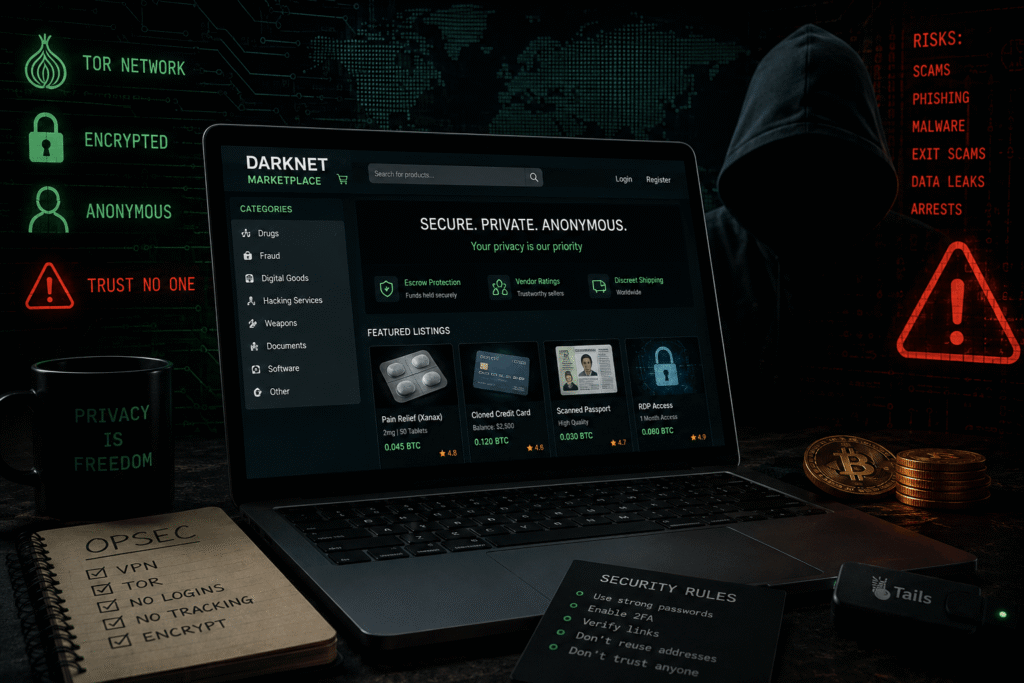
Dark web markets have existed in one form or another for more than a decade, yet the ecosystem continues to change. In 2026, stronger cybersecurity tools, cryptocurrency tracing, international law-enforcement operations, sophisticated phishing campaigns, and increasingly convincing scams have made the underground web very different from its early years.
Dark web marketplaces are often portrayed as anonymous online stores hidden beyond the reach of ordinary search engines. The reality is considerably messier. Markets disappear without warning, administrators steal deposited funds, phishing sites imitate established platforms, databases are compromised, and supposedly anonymous users can expose themselves through surprisingly small mistakes.

Understanding these environments is useful from a cybersecurity perspective because many techniques observed around underground markets eventually appear elsewhere on the internet.
This guide examines how dark web markets operate, the security systems surrounding them, and the major risks people encounter in 2026.
What Is a Dark Web Market?
A dark web market is an online marketplace hosted on infrastructure intended to make its location or operators more difficult to identify.
Unlike normal e-commerce websites that can typically be accessed through Chrome, Safari, or another conventional browser, many dark web services use .onion addresses accessible through the Tor network.
The underlying concept isn’t automatically illegal. Tor and onion services have legitimate applications, including privacy protection, anonymous communication, journalism, and censorship resistance.
The problem is that the same privacy properties can also attract criminal marketplaces.
Historically, underground markets have advertised things such as stolen information, compromised accounts, counterfeit products, malware, drugs, and other illegal goods or services.
This combination of anonymity and criminal activity creates an environment where virtually everyone has an incentive to hide their identity.
Why Dark Web Markets Keep Changing
Dark web marketplaces rarely have the stability people expect from legitimate online businesses.
A conventional e-commerce company wants customers to know who operates it. It maintains payment relationships, business registrations, customer-support channels, and a recognizable brand.
Underground markets operate under completely different pressures.
Administrators may attempt to conceal their identities from law enforcement. Vendors may conceal their identities from both administrators and customers. Buyers may attempt to conceal their activities from everyone involved.
At the same time, criminals may be attacking one another.
The result is an ecosystem where a marketplace that appears established today could disappear tomorrow.
Several events commonly cause markets to vanish:
- Law-enforcement seizures
- Administrator arrests
- Exit scams
- Server compromises
- Internal disputes
- Cryptocurrency theft
- Database leaks
- DDoS attacks
- Infrastructure failures
A market disappearing does not necessarily reveal which of these events occurred.
That uncertainty itself creates opportunities for scammers.
The Myth of Complete Dark Web Anonymity
One of the biggest misconceptions surrounding dark web markets is that using Tor automatically makes someone completely anonymous.
It doesn’t.
Tor can provide important privacy protections, but anonymity depends on far more than the network connection.
People can accidentally reveal identifying information through account reuse, cryptocurrency transactions, browser behavior, downloaded files, communication patterns, usernames, email addresses, or information they voluntarily disclose.
Investigators also don’t necessarily need to “break Tor.”
An investigation can instead target weaknesses surrounding a service.
For example, investigators may analyze financial transactions, seize servers, obtain information from other suspects, infiltrate criminal communities, or connect multiple pieces of information gathered over time.
Privacy is therefore better understood as a system rather than a single piece of software.
Cryptocurrency Doesn’t Automatically Mean Anonymous
Cryptocurrency became closely associated with dark web markets because digital payments can operate without traditional card-processing networks.
But cryptocurrency and anonymity are not the same thing.
Many blockchain networks maintain public transaction histories.
Transactions can potentially be examined years after they occur.
Blockchain-analysis companies and investigators can study transaction relationships, movement patterns, exchange deposits, and other information in an attempt to associate cryptocurrency activity with real-world entities.
This has changed the underground economy considerably.
A transaction that appears difficult to investigate today could become easier to analyze later as investigative techniques improve or additional information becomes available.
The permanent nature of many blockchain records makes that particularly important.
Phishing Is One of the Biggest Dark Web Risks
Dark web users face the same phishing problem found on the normal internet, except verification can be considerably harder.
An onion address can contain a long sequence of characters.
A fake marketplace may therefore create pages that closely imitate another service and attempt to convince visitors that they have reached the legitimate site.
The objective might be to steal login credentials, cryptocurrency, recovery information, or other sensitive data.
Attackers may also distribute fraudulent addresses through forums, search results, directories, social media, or compromised accounts.
A convincing clone can reproduce the original site’s:
- Logo
- Login page
- Product listings
- User interface
- Marketplace name
- Support pages
The victim may notice nothing unusual until funds disappear.
Fake Dark Web Markets
Sometimes there isn’t even a real marketplace behind the interface.
A scammer can create an entire website designed solely to collect deposits.
Fake markets may contain fabricated vendor accounts, invented reviews, fake transaction histories, and automated messages designed to make the platform appear active.
A visitor deposits cryptocurrency expecting to make a purchase.
Withdrawal suddenly fails.
Support stops responding.
The supposed marketplace then disappears.
Because underground markets don’t provide the consumer protections available through legitimate commerce, recovering stolen funds can be extremely difficult.
Exit Scams Remain a Major Threat
An exit scam occurs when marketplace operators deliberately disappear with funds controlled by the platform.
Imagine a market gradually accumulating cryptocurrency belonging to thousands of users.
As the platform grows, the administrators may eventually control a substantial amount of money.
Instead of continuing to operate the service, they shut it down and keep the funds.
Initially, users may believe the website is experiencing technical problems.
Then communication channels disappear.
Eventually, it becomes clear that the administrators are unlikely to return.
Ironically, a marketplace’s success can increase the incentive for its operators to exit scam.
The larger the balances under their control, the more valuable disappearing becomes.
The Problem With Marketplace “Reviews”
Searching for information about underground marketplaces introduces another security problem: fake reviews.
A website claiming to independently review dark web markets might actually be controlled by an affiliate, scammer, phishing operator, or marketplace administrator.
Reviews can therefore be manipulated to push visitors toward fraudulent services.
Fake communities can create the appearance of consensus through:
- Fabricated testimonials
- Purchased accounts
- Copied forum discussions
- Fake screenshots
- Artificial ratings
- Coordinated comments
The problem has become more significant as generative AI makes large amounts of realistic-looking content inexpensive to produce.
A polished review page should never automatically be interpreted as evidence that the underlying service is legitimate.
Malware and Dangerous Downloads
Another major dark web security risk comes from downloaded files.
A file advertised as software, documentation, a database, or another digital product could contain malicious code.
Attackers may use downloads to distribute information-stealing malware, remote-access tools, ransomware, cryptocurrency stealers, or other malicious software.
The risk extends beyond obvious executable files.
Documents and archives can also be weaponized or used as part of social-engineering campaigns.
This is one reason cybersecurity researchers generally treat files obtained from untrusted underground sources as potentially hostile.
Stolen Data Can Be Fake Too
Dark web discussions frequently involve supposedly leaked databases.
But a listing claiming to contain millions of records doesn’t prove those records exist.
Fraudsters may recycle old breaches, combine information from several previous leaks, generate fake records, or simply advertise nonexistent databases.
Sometimes a small sample of legitimate information is used to make a much larger fraudulent claim appear believable.
This creates an unusual situation where criminals themselves become targets of fraud.
A person attempting to purchase stolen information may discover that the seller is selling information that was already publicly leaked years earlier—or nothing at all.
Why Reputation Systems Don’t Solve the Problem
Many underground marketplaces have historically attempted to copy features from legitimate e-commerce platforms.
That includes vendor ratings, reviews, dispute systems, and transaction histories.
These systems are intended to create trust between people who don’t know one another.
But reputation itself can be manipulated.
Accounts can be compromised.
Reviews can be fabricated.
Marketplace administrators can alter databases.
A previously reliable vendor account can suddenly change ownership.
And a marketplace operator ultimately controls the infrastructure displaying the reputation information.
The fundamental problem remains: users are relying on systems operated by anonymous parties who may have little accountability.
Law Enforcement and Dark Web Markets
International law-enforcement agencies have spent years developing techniques for investigating underground marketplaces.
Operations can involve cooperation between multiple countries and agencies.
Rather than relying on one investigative technique, authorities can combine information from numerous sources.
Investigations may involve server infrastructure, financial records, cryptocurrency analysis, undercover operations, seized devices, communications, and information obtained during previous investigations.
Sometimes a marketplace continues operating while investigators quietly gather evidence.
That means the fact that a dark web service is currently online doesn’t necessarily mean its operators are unknown.
The Security Lessons Behind Dark Web Markets
Dark web marketplaces provide an extreme example of a broader cybersecurity principle:
Technology cannot create trust by itself.
Encryption can protect communications.
Tor can improve network privacy.
Cryptography can authenticate information.
Cryptocurrency can transfer value.
But none of these technologies can guarantee that the person on the other side of a transaction is trustworthy.
The same principle applies to ordinary internet users.
A website can have HTTPS and still be fraudulent.
An email can look professional and still be phishing.
A cryptocurrency transaction can be technically valid while sending money to a scammer.
Cybersecurity therefore requires evaluating both technology and human behavior.
Dark Web Markets vs. the Legitimate Web
The boundary between dark-web threats and ordinary cybercrime has also become increasingly blurred.
Credentials stolen through phishing on the normal web can later circulate in underground communities. Malware distributed through ordinary websites can steal information that eventually appears in criminal marketplaces.
Likewise, scam advertisements may begin on mainstream social networks before directing victims toward private messaging platforms or obscure websites.
Cybercrime is better understood as an interconnected ecosystem rather than two completely separate internets.
Hidden Risks in 2026
The greatest danger surrounding dark web markets isn’t necessarily some exotic hacking technique.
It’s uncertainty.
You may not know who operates a service.
You may not know whether its security claims are true.
You may not know whether a marketplace has already been compromised.
You may not know whether reviews are genuine.
You may not know whether a download contains malware.
And you may not know whether the person you’re communicating with is who they claim to be.
That uncertainty creates an environment where scams can thrive.
Frequently Asked Questions
Are dark web markets illegal?
The dark web itself isn’t illegal. Legality depends on what a person does with it and the laws of their jurisdiction. Many activities associated with criminal marketplaces, however, can obviously be illegal.
Is Tor illegal?
Tor is legal in many countries and has legitimate privacy, journalism, research, and censorship-resistance uses. Local laws and restrictions vary.
Are dark web marketplaces anonymous?
They can provide privacy features, but complete anonymity should never be assumed. Investigators have repeatedly identified operators and users of underground services.
Can dark web marketplaces steal cryptocurrency?
Yes. Fraudulent markets and exit scams can result in users losing deposited funds.
Are dark web market reviews trustworthy?
Not automatically. Reviews, ratings, screenshots, and testimonials can all be manipulated.
Why do dark web markets disappear?
Possible causes include law-enforcement action, exit scams, infrastructure problems, hacking, internal disputes, and deliberate shutdowns.
Is cryptocurrency anonymous on the dark web?
Not necessarily. Many cryptocurrency blockchains contain publicly visible transaction records that can be analyzed.
Can dark web downloads contain malware?
Yes. Files from unknown sources should be considered potentially dangerous because malicious software can be disguised as legitimate downloads.
Can a dark web market be hacked?
Yes. Hidden services are still software systems and can suffer from vulnerabilities, compromised credentials, configuration errors, malicious insiders, and other security problems.
Do law-enforcement agencies monitor dark web markets?
Law-enforcement agencies around the world investigate criminal activity involving dark web services. Investigations can combine digital forensics, cryptocurrency tracing, infrastructure analysis, undercover work, and traditional investigative techniques.
Final Thoughts
Dark web markets in 2026 remain one of the internet’s clearest examples of the conflict between privacy technology and human trust.
Tor, encryption, cryptocurrency, and other technologies can provide powerful security properties, but they cannot prevent an anonymous marketplace administrator from lying, a vendor from scamming customers, or an attacker from creating a convincing phishing site.
Markets can disappear. Databases can leak. Cryptocurrency can be stolen. Reviews can be manufactured. Infrastructure can be seized.
For cybersecurity researchers and ordinary internet users alike, the most valuable lesson is simple: anonymity should never be confused with trust.
Understanding how these environments fail provides useful lessons far beyond the dark web—especially when evaluating phishing, cryptocurrency scams, malware, data breaches, and online fraud across the wider internet.