DIY
DIY
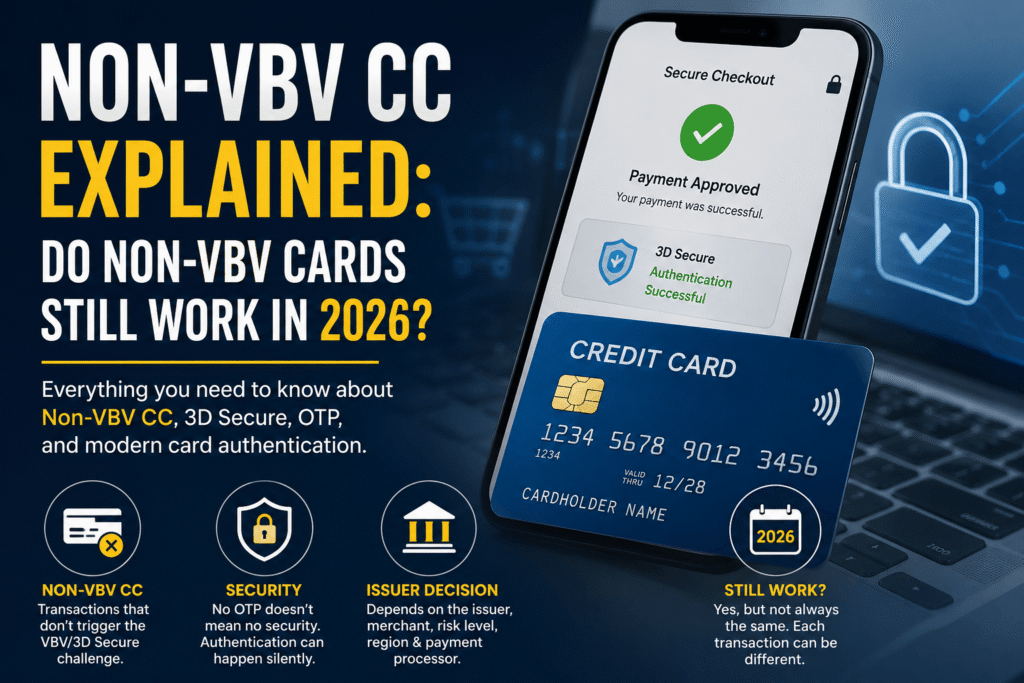
If you have spent any time reading about online payments, credit card security, or 3D Secure, you may have encountered the term Non VBV CC. It is especially common on forums and websites discussing payment processing, but the terminology can be confusing because online card security has changed significantly over the years.
So, what is a Non VBV CC? And do Non VBV cards actually still work in 2026?

The short answer is that “Non VBV” is largely an informal and outdated term. It traditionally describes a card or card transaction that does not present the classic Verified by Visa authentication step. However, not seeing an OTP or verification page does not necessarily mean that a card has no 3D Secure protection.
Modern payment systems can perform authentication silently in the background, making the situation considerably more complicated than the old distinction between “VBV” and “Non-VBV.”
This guide explains what Non-VBV CC means, where the terminology came from, how modern 3D Secure works, and why some legitimate online payments still go through without asking the cardholder for an OTP.
What Is a Non VBV CC?
CC is commonly used as an abbreviation for credit card, while “VBV” refers to Verified by Visa.
Verified by Visa was Visa’s branding for its implementation of the 3D Secure authentication system.
Historically, when a cardholder made an online purchase from a participating merchant, an additional authentication screen could appear during checkout. Depending on the bank and the technology being used, the customer might have been asked for a password, security code, or later a one-time password sent to their phone.
Cards or transactions that did not produce this additional verification screen became informally known online as Non VBV CC.
However, that terminology oversimplifies how payment authentication actually works today.
A card cannot necessarily be permanently classified as “VBV” or “Non-VBV” based solely on whether an OTP appeared during one transaction.
Where Did the Term Non-VBV Come From?
To understand the terminology, it helps to look at the history of online card payments.
Early e-commerce transactions generally relied heavily on information printed on the payment card, including the:
- Card number
- Expiration date
- Cardholder name
- Security code
As online shopping expanded, payment networks and banks needed stronger ways of determining whether the person entering those details was actually the legitimate cardholder.
3D Secure was introduced as an additional authentication layer.
Visa branded its implementation Verified by Visa, which eventually made “VBV” a recognizable term among online shoppers.
Other payment networks introduced similar authentication programs.
Over time, internet communities began referring to transactions that did not display the Verified by Visa challenge as “Non-VBV.”
The terminology survived even as the underlying technology evolved.
Is Verified by Visa Still Used in 2026?
The technology behind it continues to exist, but the terminology has changed.
Visa’s modern consumer-facing authentication branding is Visa Secure, and the payment industry has moved toward newer generations of the 3D Secure (3DS) protocol.
Modern 3D Secure systems are substantially different from the early versions many people associate with Verified by Visa.
Instead of automatically interrupting customers with another password screen, modern authentication systems can analyze information about a transaction before deciding whether additional verification is necessary.
This allows many legitimate transactions to proceed without the customer noticing that authentication occurred.
How Modern 3D Secure Works
Modern 3D Secure is designed to evaluate the risk surrounding an online transaction.
During checkout, information may be exchanged between the merchant, payment processor, card network, and issuing bank.
Depending on the implementation, risk analysis can consider signals associated with the transaction and device.
If the issuer determines that the transaction appears legitimate, authentication may occur without requiring additional interaction from the customer.
This is commonly known as a frictionless flow.
If additional confirmation is required, the transaction may instead enter a challenge flow.
The customer could then be asked to verify the payment using something such as:
- A banking application
- A one-time password
- Biometric authentication
- Another verification method provided by the issuing bank
The exact process varies between banks, countries, merchants, and payment networks.
Why Some Card Payments Don’t Ask for an OTP
One of the biggest misconceptions surrounding Non-VBV CC discussions is that every secure online payment must produce an OTP.
That isn’t necessarily true.
Modern payment authentication attempts to reduce unnecessary interruptions for legitimate customers.
For example, imagine purchasing something from an online store you regularly use.
Your bank may have numerous signals suggesting that the transaction is consistent with your normal activity.
Depending on the merchant, issuer, applicable regulations, and authentication setup, the transaction might proceed without requiring an additional challenge.
A different transaction using the same card could potentially trigger additional verification.
Therefore:
No OTP does not automatically mean no security.
Authentication can sometimes happen behind the scenes.
Do Non VBV Cards Still Work in 2026?
This depends heavily on what someone means when they say “Non-VBV card.”
If they mean a special category of credit card that permanently bypasses modern payment authentication, that description is misleading.
Payment security does not generally operate through such a simple classification.
The same legitimate card could experience different checkout processes depending on the transaction.
One purchase might proceed without an OTP.
Another might require approval through a banking application.
Another could be declined entirely.
These differences can occur because authentication and authorization decisions involve multiple systems.
That is why describing a card simply as “Non-VBV” does not provide enough information to predict how every future transaction will behave.
Non VBV vs 3D Secure Cards
The traditional internet distinction looks something like this:
VBV / 3D Secure transaction:
The cardholder encounters additional authentication during checkout.
Non-VBV transaction:
The checkout completes without an obvious Verified by Visa challenge.
But modern systems make this distinction less useful.
A transaction protected by modern 3D Secure may complete using frictionless authentication.
From the customer’s perspective, it might appear that nothing happened.
Behind the scenes, however, authentication information may still have been exchanged and evaluated.
This is one reason older terminology can cause confusion.
Does Non VBV Mean a Card Is Easier to Use Online?
Not necessarily.
A lack of a visible 3D Secure challenge does not guarantee that a transaction will be approved.
Online card payments involve both authentication and authorization, and these are not exactly the same thing.
Authentication helps determine whether the person initiating a payment is genuinely associated with the card.
Authorization determines whether the issuing bank approves the transaction.
An issuer can still decline a transaction even when no OTP appears.
Banks and payment processors operate fraud-detection systems that can evaluate transactions separately from the visible authentication process.
As a result, a transaction could fail because of factors completely unrelated to whether a traditional VBV screen appeared.
Why Does the Term “Non VBV CC” Remain Popular?
There is a simple reason: old terminology tends to survive on the internet.
People searching for information about card authentication may encounter older forum discussions, archived tutorials, security articles, and payment terminology that continues to use VBV.
Search engines can then reinforce the terminology because people continue searching for phrases such as:
“Non VBV CC”
“Non VBV cards”
“VBV vs Non VBV”
“Does Non VBV still work?”
The phrase therefore remains recognizable even though modern payment infrastructure has moved beyond the simple VBV versus Non VBV distinction.
Are Non VBV CC Lists Reliable?
Claims that particular cards or BIN ranges are permanently “Non-VBV” should be treated cautiously.
A BIN, or Bank Identification Number, can provide information associated with the institution or payment product that issued a card.
It does not provide a universal guarantee about how every transaction will be authenticated.
Payment behavior can change based on the issuing bank’s systems, merchant configuration, payment processor, location, regulatory requirements, transaction characteristics, and risk assessment.
Banks and payment networks can also modify their security systems over time.
A claim made about a particular payment product months or years ago may therefore no longer reflect its current behavior.
Is a Card Without an OTP Insecure?
Not automatically.
Visible authentication is only one part of modern payment security.
Banks and payment companies can use multiple security technologies to identify suspicious transactions.
For consumers, the most important protection remains good card security practices.
Never publicly share your full card number, CVV, PIN, online banking password, or OTP.
Legitimate financial institutions generally won’t ask customers to disclose sensitive authentication credentials through unsolicited messages.
Customers should also monitor transaction notifications and immediately report payments they don’t recognize to their card issuer.
Non VBV CC Myths
Several misconceptions continue to circulate around this subject.
Myth 1: Non VBV means there is no fraud protection
False.
Banks can operate multiple fraud-detection systems independently of a visible 3D Secure challenge.
Myth 2: No OTP means the transaction wasn’t authenticated
Not necessarily.
Modern 3D Secure can support frictionless authentication where no additional action is required from the customer.
Myth 3: A particular card will always behave the same way
Not necessarily.
Authentication requirements can vary between transactions.
Myth 4: Non VBV guarantees payment approval
False.
The issuing bank still determines whether a card transaction is authorized.
Myth 5: Non VBV is an official modern credit-card category
Generally, no.
It is better understood as informal terminology originating from the era when Verified by Visa was a widely recognized name for Visa’s online authentication system.
The Future of Card Authentication
The payment industry is gradually moving toward security systems that provide stronger authentication without making legitimate purchases unnecessarily difficult.
Rather than challenging every customer with passwords and verification screens, modern systems increasingly rely on risk-based authentication.
That means customers may see fewer interruptions during normal transactions while suspicious activity can receive additional scrutiny.
Mobile banking applications and biometric authentication have also become increasingly important.
As these technologies evolve, terminology such as “VBV” and “Non VBV” will become even less useful for describing how card security actually operates.
Frequently Asked Questions
What does Non VBV CC mean?
Non-VBV CC traditionally refers to a credit card or transaction that does not display the classic Verified by Visa authentication challenge during an online purchase.
What does VBV stand for?
VBV stands for Verified by Visa, an older Visa branding associated with 3D Secure authentication.
Do Non VBV cards still exist in 2026?
The phrase is still used online, but treating Non-VBV as a permanent category of card is misleading. Modern authentication can vary depending on the transaction, issuer, merchant, and risk assessment.
Does no OTP mean a card is Non VBV?
No. A payment may complete without an OTP because modern authentication systems can sometimes authenticate legitimate transactions without presenting a challenge.
Can the same card sometimes require an OTP and sometimes not?
Yes. Depending on the issuer and payment environment, one transaction may proceed without additional interaction while another may require further authentication.
Does Non-VBV guarantee that a payment will go through?
No. Authentication is only one component of the payment process. The issuing bank can still approve or decline the transaction.
What is 3D Secure?
3D Secure is an authentication framework designed to provide additional protection for online card transactions. Modern versions can support both frictionless authentication and transactions requiring additional cardholder verification.
Is Verified by Visa the same as Visa Secure?
Visa Secure is the newer branding associated with Visa’s online payment authentication technology. “Verified by Visa” is the older name many internet users still recognize.
Are Non VBV BIN lists accurate?
They should not be treated as a guarantee of authentication behavior. Payment security configurations and issuer policies can change, and individual transactions can be treated differently.
Why do people still search for Non VBV CC?
The terminology became widespread during the earlier years of 3D Secure and remains common in online discussions despite changes in payment technology.
Final Thoughts
So, do Non VBV cards still work in 2026?
The better question is whether “Non VBV” still accurately describes modern card authentication.
In most situations, it doesn’t.
The term comes from an earlier generation of online payment security when customers could easily distinguish transactions that displayed a Verified by Visa screen from those that didn’t.
Today’s systems are much more sophisticated.
A legitimate payment can complete without an OTP while still being evaluated or authenticated behind the scenes. The same card may also face additional verification on another transaction.
For that reason, consumers should not assume that a card is permanently Non VBV cc simply because a previous purchase didn’t produce an authentication challenge.
In 2026, understanding 3D Secure, frictionless authentication, issuer authorization, and risk-based security provides a much more accurate picture of how online card payments actually work.