DIY
DIY

non VBV BIN list 2026 or non-VBV BIN lists have become increasingly common among people researching online card payments, BIN information, and 3-D Secure authentication.
But there is a lot of outdated and misleading information surrounding the subject.

Terms such as VBV, non-VBV, BIN, IIN, 3-D Secure, Visa Secure, and card authentication are often mixed together, even though they describe different parts of the payment ecosystem.
So, what does a non-VBV BIN actually mean? Does a BIN determine whether a transaction will require verification? And are online “non VBV BIN lists” still reliable in 2026?
Let’s break it down.
What Is a BIN?
A BIN, or Bank Identification Number, refers to the identifying digits at the beginning of a payment card number. The industry increasingly uses the broader term IIN (Issuer Identification Number).
BIN/IIN information can be associated with details such as:
- Card network
- Issuing institution
- Card type
- Country or region
- Product category
- Other publicly available classification information
BIN databases are commonly used by legitimate businesses for payment processing, fraud prevention, transaction analysis, and routing.
However, a BIN should not be confused with an authentication setting.
A BIN can identify characteristics associated with a card range, but it does not automatically determine exactly how every future transaction will be authenticated.
What Does Non VBV Mean?
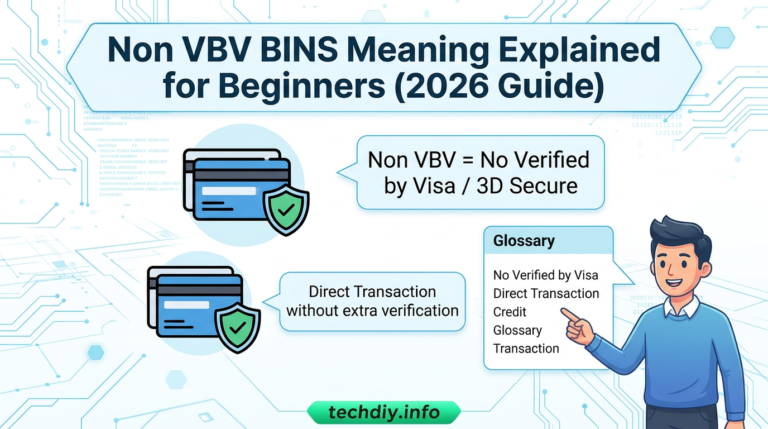
VBV traditionally stood for Verified by Visa, an older name associated with Visa’s 3-D Secure authentication service.
Visa has since moved to the Visa Secure branding.
The term non-VBV is therefore mostly an informal expression used online to describe a transaction or payment flow where the traditional Verified by Visa authentication experience is not presented.
That doesn’t necessarily mean that the transaction has no security.
Modern payment systems can use risk-based authentication and other security measures without requiring customers to complete a visible verification challenge.
This distinction is extremely important when researching non-VBV BIN lists.
Is a BIN Automatically Non VBV?
Not necessarily.
This is one of the biggest misconceptions surrounding the topic.
A card’s BIN identifies an issuing range and certain card characteristics. It does not necessarily guarantee that every transaction associated with that BIN will behave identically.
Authentication can depend on multiple factors, including:
- The card issuer
- Merchant
- Payment processor
- Card network
- Transaction details
- Merchant category
- Country
- Risk assessment
- Applicable regulations
- Authentication capabilities
As a result, a static database that labels an entire BIN range simply as “non VBV” may not accurately predict what happens during a particular transaction.
Why Do People Search for Non VBV BIN Lists?
There are several reasons the keyword appears frequently in search results.
Some people are researching how online payments work. Others are trying to understand why one transaction produces an authentication request while another doesn’t.
Businesses may also research BIN information for legitimate purposes such as:
- Fraud prevention
- Payment analytics
- Customer segmentation
- Transaction routing
- Risk management
- Card-type identification
The problem is that many websites present BIN information as if it guarantees a particular authentication result.
Modern payment processing is considerably more complicated than that.
How 3-D Secure Works
3-D Secure, commonly abbreviated as 3DS, is an authentication framework designed to provide an additional layer of security for online card payments.
Depending on the circumstances, a customer may experience:
Frictionless authentication
The transaction can be assessed without requiring the customer to complete a visible challenge.
Challenge authentication
The customer may be asked to complete an additional verification step.
This could involve authentication through a banking application, a one-time code, biometric verification, or another method controlled by the card issuer.
Therefore, seeing no verification screen does not necessarily mean that the payment had no authentication or fraud controls.
VBV vs Visa Secure
If you’ve been researching VBV BIN lists, you’ll probably encounter both “VBV” and “Visa Secure.”
The terminology can be confusing.
Verified by Visa was the older consumer-facing terminology.
Visa Secure is the newer branding associated with Visa’s 3-D Secure authentication experience.
The underlying concept is still related to helping authenticate cardholders during online transactions, but the technology and customer experience have evolved.
That’s why older articles using “VBV” terminology may no longer accurately describe how modern online payments work.
Non-VBV vs 3-D Secure
These terms shouldn’t be treated as simple opposites.
| Term | Meaning |
|---|---|
| BIN/IIN | Identifies an issuer/card range |
| VBV | Legacy Verified by Visa terminology |
| Visa Secure | Current Visa 3-D Secure branding |
| 3-D Secure | Online card authentication framework |
| Non-VBV | Informal term describing the absence of the traditional VBV experience |
| Frictionless authentication | Authentication that doesn’t require a visible challenge |
| Challenge | Additional verification presented to the customer |
The important point is that authentication behavior isn’t determined by a BIN alone.
Why Some Payments Don’t Ask for Verification
You may have completed an online purchase where the payment went through without receiving a code or opening your banking application.
That doesn’t automatically indicate that the payment was “non-secure.”
Modern payment systems can analyze transaction information and assess risk before deciding whether an additional customer challenge is necessary.
A lower-risk transaction may be handled differently from a transaction that triggers additional verification.
The exact process depends on the payment ecosystem and the parties involved.
Are Non-VBV BIN Lists Accurate?
This is where consumers should be particularly careful.
A website may advertise a list as a collection of “non-VBV BINs,” but that doesn’t mean every BIN on the list will permanently produce the same authentication behavior.
Card programs can change.
Issuers can change authentication policies.
Merchants can change payment configurations.
Processors can update their systems.
Regulatory requirements can also affect payment authentication.
Therefore, a BIN list should not be treated as a guarantee of transaction behavior.
For legitimate businesses, current BIN/IIN data should be sourced from reputable providers and used for appropriate payment-risk and classification purposes.
Can BIN Information Change?
The characteristics associated with card ranges can change over time.
Financial institutions introduce new products, modify existing programs, and update their payment infrastructure.
A database that was accurate months ago may therefore contain outdated information.
This is another reason why searches such as “non-VBV BIN list 2026” shouldn’t automatically lead readers to assume that an old list remains accurate.
Current payment behavior is determined by more than the first digits of a card number.
Non-VBV Sites: What Does That Mean?
Another popular search phrase is “non VBV sites.”
The term is often used loosely online to describe websites where users claim that an additional cardholder authentication step isn’t displayed.
However, a legitimate website doesn’t necessarily have a permanent “non-VBV” status.
The authentication experience can vary according to the merchant, processor, card issuer, payment network, transaction, and risk assessment.
For consumers, the better approach is to evaluate whether the website itself is trustworthy rather than relying on a label such as “non-VBV.”
What Consumers Should Look For
When making online purchases, focus on the overall security of the merchant and payment environment.
Good practices include:
- Use reputable merchants.
- Check that the website uses HTTPS.
- Keep banking applications updated.
- Enable transaction notifications.
- Never share verification codes with another person.
- Monitor account activity.
- Contact your bank if you notice an unfamiliar transaction.
- Avoid websites making unrealistic claims about payment security.
A payment should never be considered safe simply because it doesn’t display a verification challenge.
Frequently Asked Questions
What is a non VBV BIN list?
A non-VBV BIN list generally refers to a collection of BIN/IIN ranges that someone has labeled as being associated with transactions that don’t use the traditional VBV authentication experience. Such labels aren’t a guarantee of how a future transaction will be authenticated.
Does a BIN determine 3-D Secure?
No. BIN information alone doesn’t determine whether a particular transaction will require 3-D Secure authentication.
Is VBV still used?
“Verified by Visa” is legacy terminology. Visa now generally uses Visa Secure for its 3-D Secure authentication service.
Is non-VBV the same as no security?
No. A transaction can use risk assessment and other security mechanisms without displaying a traditional authentication challenge.
Why did my card payment not ask for a code?
Some transactions can be authenticated without a visible customer challenge. The exact decision depends on the payment ecosystem and transaction circumstances.
Are non-VBV BIN lists permanent?
No. Payment programs, issuer policies, processors, and authentication systems can change, so static lists shouldn’t be considered permanent guarantees.
Final Thoughts
The phrase non VBV BIN list can sound straightforward, but the reality of modern card payments is much more complicated.
A BIN or IIN can provide useful information about a card range, but it shouldn’t be treated as a guaranteed indicator of authentication behavior.
The transition from traditional VBV terminology toward modern 3-D Secure and Visa Secure systems has also made many older explanations outdated.
For anyone researching online payments in 2026, the most important distinction is simple:
BIN information identifies card characteristics; authentication decisions involve the broader payment ecosystem.
Understanding that difference makes it much easier to separate genuine payment information from outdated or misleading claims found online.