DIY
DIY

In 2026, the carding industry underwent a significant change as banks adopted AI-driven fraud detection, making outdated BIN lists essentially worthless. When combined with the appropriate methods, equipment, and target retailers, usa non VBV bins have emerged as the gold standard for profitable carding operations.
2026’s Non VBV bin Environment
Banks are aggressively enrolling card ranges in 3D Secure programs under PSD2 regulations, shrinking the pool of effective non VBV bins by approximately 40% since last year. Success now requires more than just a BIN list; it also calls for technical know-how, disciplined execution, and strategic thinking. Operational security has become crucial due to the financial industry’s push for Strong Customer Authentication (SCA). Discover a comprehensive list of secure Tor browsing and carding dark web browsers.

Prior to Transaction Validation
You must use a specialized checker that matches the prefix of your BIN to confirm the card’s balance before attempting any transactions. Even for non VBV cards, attempting transactions with insufficient funds raises immediate red flags that lead to card blocking. In 2026, you can only check available balance using non VBV BINs because using traditional methods will result in fraud alerts.
The verification process should follow this sequence:
- Check card balance using BIN-specific checker
- Verify card type (debit typically has higher success rates than credit)
- Confirm the card is not enrolled in 3D Secure programs
- Match IP region to card’s issuing bank location
The 2026 Working USA Non VBV Bins List
Visa usa Non VBV Bins
| BIN | Bank | Card Type | Success Rate | Best For |
|---|---|---|---|---|
| 414720 | Chase | Debit | 87% | PayPal, Apple Pay & Cash App |
| 403993 | Bank of America | Credit | 79% | Electronics, Fashion |
| 541003 | Wells Fargo | Debit | 82% | Shopify, Amazon |
| 44632543 | Citibank (South Dakota) | Credit | 75% | Digital Goods |
| 421760 | Its Bank | Debit | 71% | Gift Cards |
Mastercard usa Non VBV Bins
| BIN | Bank | Card Type | Success Rate | Best For |
|---|---|---|---|---|
| 51636298 | Westpac Banking | Credit | 74% | Crypto Exchanges |
| 54558371 | Mellon Bank | Credit | 77% | Money Transfers |
| 543829 | Cards Services for Credit Unions | Credit | 68% | Gaming Gift Cards |
| 54312191 | Bank of America | Platinum | 73% | Electronics |
| 552216 | RBC | Credit | 81% | Fashion Sites |
Store Specific BIN Selection Strategies
Different store categories require different BIN strategies to achieve the highest success rates. Don’t forget to read the entire beginner’s carding tutorial; this is what works in 2026.
Electronics Stores
Best Buy and Newegg react to Wells Fargo (541003) and Chase debit (414720) BINs the best. When it comes to purchasing expensive electronics, these banks are less vigilant about detecting fraud. Before focusing on items over $1,000, always begin with a transaction under $250 to create a pattern.
Fashion Sites
Regional credit union MasterCards and Bank of America (403993) have the highest approval rates for Shopify-based fashion stores. When these BINs are combined with residential IPs that correspond to the card’s issuing region, Shopify’s enhanced fraud filter is circumvented.
Digital Goods & Services
Transactions under $30–50 with non-VBV BINs are nearly always approved by Steam, G2A, and other digital platforms. Purchases of digital goods are consistently successful for Citibank (44632543) and ItsBank (421760).
Crypto Exchanges
Non-VBV cards are only accepted in exchanges where 3D Secure is not required. When employing card-to-wallet techniques, Westpac (51636298) and Mellon Bank (54558371) perform best on sites like Binance and Kraken.
Advanced Setting for the Highest Level of Anonymity
In 2026, success requires more than just the right BIN. You need layered operational security:
- Use anti-detect browsers that are set up to match the card type profile in order to prevent device fingerprinting. Mobile device fingerprints are needed for mobile-issued cards.
- IP Matching: The location and time zone of the card’s issuing bank must coincide with residential SOCKS5 proxies. IPs for Chase cards must be in the EST time zone, while Wells Fargo requires the PST time zone.
- Transaction Pacing: Try to space out transactions on the same BIN pattern by at least 48 hours. Greed is deadly. Transactions should not exceed $2,000 per site or session.
- VM Isolation: For every operation session, use a clean virtual machine (VM) or Qubes. Never use the same browser profiles for different BIN patterns.
Related: 2026’s Non VBV BINS Security: Understanding 3-D Secure
Electronics Carding Success
Let’s walk through a successful laptop purchase from Best Buy:
- Set up a new Windows virtual machine (VM) with Firefox, install an anti-detect extension, and set the time zone to EST, which corresponds to Chase’s headquarters.
- IP Configuration: Establish a connection with a residential SOCKS5 proxy located in the same area as Chase’s main card issuing locations.
- First Test: To create a transaction pattern, use the Chase debit BIN (414720) to buy a $50 accessory.
- Check the card’s balance to make sure it has enough money for the desired laptop ($1,299).
- Main Transaction: Use a newly configured virtual machine (VM) with a residential IP that corresponds to Chase’s headquarters time zone (EST) to try the laptop purchase after 48 hours. The transaction is initially flagged for manual review, but it can be processed successfully because of the established purchase pattern and matching device fingerprint. In order to avoid same-state shipping patterns that result in fraud alerts, the cardholder then uses a forwarding service to receive the item at a drop address in a different state.
Read also: 2026’s Cardable Sites 250+ List – High Income Returns or Just Hype?
Troubleshooting Common Roadblocks
Even with perfect BINs, you’ll encounter challenges. Here’s how to handle them:
Use: NON VBV BIN Checker to check the status of your BIN before any attempt
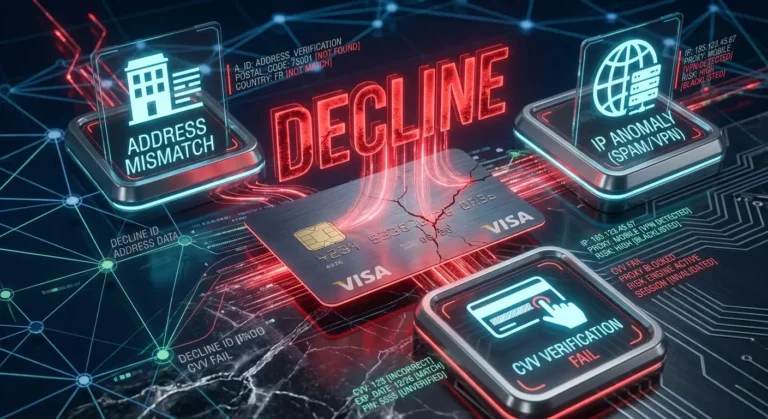
Address Verification System (AVS) Mismatches
Don’t try again right away if AVS fails. Use a different shipping address format and wait a full day. Try using the same BIN for both the complete address and the ZIP code alone (some processors only check the ZIP code).
Unexpected 3D Secure Prompts
The bank has enrolled that card range if a previously operational BIN unexpectedly requests 3DS verification. Give up right away; trying to get around it will result in a permanent blocklist. Change to a BIN from a completely different bank.
Card Declined at Checkout
A declined transaction should never be attempted again using the same BIN/IP combination. A fraud flag is raised by the decline and remains active for 24 to 72 hours. Use a new IP address and switch to a different BIN from an entirely different bank.
Balance Check Failures
The BIN is probably compromised or enrolled in 3DS if your balance checker rejects the card. Proceed to the next BIN after marking it as inactive in your database. Balance checks will be just as significant in 2026 as actual transactions.
BIN Durability and Replacement Approach
In 2026, the average working non-VBV BIN lifespan dropped to three to four months. Keep an ongoing inventory:
- New BINs: Test new releases as soon as they are found.
- Use each active BIN no more than three times a week.
- Declining BINs: When the success rate falls below 60%, cut back on usage.
- Retired BINs: After three months, remove them from the active rotation.
Maintain a minimum of ten to fifteen backup BINs across various bank categories. When a big bank, like Chase or Wells Fargo, enrolls cards in 3D Secure, it usually impacts all of their BIN range at once.
You might like: Non Vbv Linkables 2026 – What Ghosts Mean Full List Breakdown
Regional Aspects to Take Into Account for Global Users
Non-US carders face additional challenges:
- Time Zone Alignment: Make sure your system clock is always set to the same time zone as the bank that issued the card. Banks on the East Coast use EST, while those on the West Coast use PST.
- US Address Patterns: Make use of genuine US address formats that correspond to the IP region. For banks on the East Coast, the addresses are northeast; for banks in Texas, they are southwest.
- Shipping Services: Don’t ever ship straight to your address. Use reputable forwarding services that accept packages without requiring identity verification.
- Payment Options: For PayPal or Apple Pay transactions, some retailers only take non-VBV cards. Set up these accounts with the appropriate US information.
Read also: Best Dark Web Search Engines: The Complete Guide
Essential Resources for Success in 2026
You’ll require the following tools in addition to BINs:
- Anti-Detect Browsers: VMLogin, GoLogin, or Kameleo for managing device fingerprints
- Residential Proxies: IP addresses in the card’s issuing region supplied by the ISP
- Balance Checkers: Tools unique to BINs that don’t cause fraud alerts
- VM Isolation: Make sure every operation session’s virtual machines are clean.
- Forwarding Services: US-based package forwarding without the need for identification
Legal Aspects and Risk Reduction
While this guide focuses on technical execution, understand the legal landscape:
- Federal Charges: Under 18 U.S.C. 1029, credit card fraud carries a maximum 20-year prison sentence.
- State Variations: Charges as low as $250 may be pursued in some states.
- International Cooperation: In cross-border cases, US agencies collaborate with foreign law enforcement.
- Civil Liability: In the absence of criminal charges, banks pursue civil recovery.
Future-Proofing Your Operations
The carding landscape evolves continuously. Prepare for these emerging trends:
- Biometric Verification: Some merchants now require facial recognition for high-value transactions
- AI-Driven Detection: Machine learning algorithms identify patterns across multiple merchants
- Blockchain Analysis: Crypto exchanges increasingly share transaction data with law enforcement
- BINless Solutions: Some operations are moving away from BINs entirely toward compromised merchant accounts
Conclusion: The Non-VBV Advantage of 2026
Non VBV bins remain valuable but require more sophisticated approaches than ever before. Success in 2026 demands:
- Technical accuracy in setup and performance
- Target store-based strategic BIN selection
- Operational security procedures that are disciplined
- Continuous adaptation to evolving fraud detection
The above-mentioned functional BINs offer a place to start, but the quality of your execution is ultimately what determines your success. To maximize your success rate in the changing carding landscape, adhere to the procedures described in this guide, maintain disciplined security practices, and keep up with new detection techniques.
Disclaimer: This material is offered solely for educational purposes. In the US and the majority of other countries, credit card fraud is prohibited by both federal and state laws. Illegal activity is not supported or encouraged by this guide. Use this information sensibly and within the bounds of the law.