 DIY
DIY
This guide breaks down everything you need to know. What Non VBV banks are. Why Non VBV BINs are so popular in 2026. Which banks still issue Non VBV cards. Which ones to avoid. How to verify if a bank card is Non VBV. And where to source fresh Non VBV cards from trusted shops.
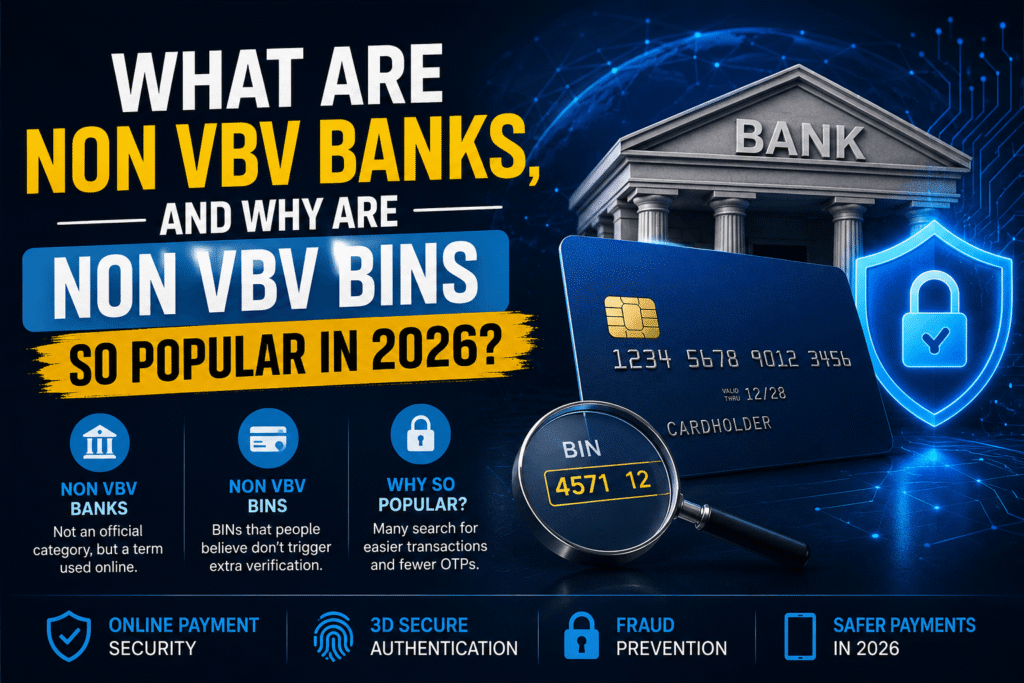
Many people assume that a “Non VBV bank” is a special type of financial institution or that “Non VBV BINs” are officially issued products. In reality, neither term is recognized as an official banking category. Instead, they are informal expressions that grew out of discussions about online card authentication and payment security.

This article explains what these terms mean, why they remain popular in 2026, and how modern payment authentication actually works.
What Does VBV Mean?
VBV stands for Verified by Visa, Visa’s original implementation of the 3D Secure authentication protocol.
Its purpose was simple: add an extra security layer when customers made purchases online. Depending on the bank and the transaction, this extra verification could include:
- A one-time password (OTP)
- Approval through a banking app
- Biometric verification
- Another form of identity confirmation
The goal was to reduce unauthorized card use while giving legitimate customers a safer shopping experience.
Today, the original VBV branding has largely been replaced by Visa Secure, which uses newer versions of the 3D Secure standard.
What Are Non VBV Banks?
Non VBV banks are financial institutions that either do not implement 3D Secure on their cards or have weaker implementations that allow transactions to pass without OTP verification. Cards from these banks are significantly more valuable for carding because they skip the final verification step at checkout.
VBV stands for Verified by Visa. Mastercard has a similar system called SecureCode. When a card is VBV enabled, online transactions trigger a verification step. The customer gets a popup asking for a password. Or they receive a one time code via SMS. Or they get a push notification on their banking app. Without that verification, the transaction declines.
Non VBV cards skip this step entirely. The transaction either approves or declines based on AVS, IP, fingerprint, and cart value. No 3DS popup. No OTP. No bank app push. This makes them the foundation of any successful carding method in 2026
Knowing which banks to target is half the battle. Source fresh non VBV cards from trusted shops. fullzplug.to , cvvplug.co , cardingclub.ru, and nonvbvshop.net . Test every card before you scale. Keep your setups clean. Burn after each use.
What Are Non VBV BINs?
A BIN (Bank Identification Number) is the first several digits of a payment card number. These digits identify information such as the issuing bank, payment network, card type, and issuing country.
The phrase “Non VBV BINs” is not an official technical classification. Instead, it is an informal label used online to describe BINs that people believe are associated with transactions that do not always trigger an additional authentication prompt.
In reality, whether a purchase requires extra verification depends on many factors beyond the BIN itself.
Why Are These Terms Still Popular?
Non VBV BINs are popular because they are the key to bypassing 3DS verification. Without them, most online transactions fail. The 3DS popup stops the transaction cold. No amount of ghost setup can bypass 3DS once the bank forces it.
Non VBV BINs allow ghosts to slide clean on sites that enforce 3DS. They approve faster and more consistently than VBV cards. They work on digital goods, gift codes, food delivery, crypto casinos, and regional fashion sites. They are the foundation of low ticket carding.
The popularity of Non VBV BINs has grown because banks have been patching VBV into more and more card ranges. The supply of Non VBV cards is shrinking. This makes them more valuable. Ghosts who know where to find fresh Non VBV BINs have a significant advantage over those who do not.
In 2026, Non VBV BINs are the most sought after commodity in the carding ecosystem. Fresh Non VBV cards sell for premium prices. Dead or VBV cards are almost worthless. Understanding which BINs are Non VBV and where to source them is the difference between eating and crying about patches.
Why Don’t All Transactions Require an OTP?
One of the biggest misconceptions is that every online payment should generate a one-time password.
Modern payment authentication works differently.
Today’s payment systems use risk-based authentication, which evaluates multiple signals before deciding whether additional verification is necessary.
These signals may include:
- Previous purchasing behavior
- Device reputation
- Geographic location
- Merchant risk profile
- Transaction amount
- Network intelligence
If the transaction appears low risk, it may proceed without displaying an additional authentication challenge. If it appears unusual or risky, the customer may be asked to verify their identity.
Has VBV Disappeared?
Not entirely.
While many people still use the phrase Verified by Visa, the payment industry has largely transitioned to newer technologies.
Modern authentication includes:
- Visa Secure
- Mastercard Identity Check
- EMV 3D Secure
- Tokenization
- Biometric verification
- Risk-based authentication
These systems improve security while reducing unnecessary interruptions during checkout.
Why Some Banks Stay Non VBV in 2026
You might wonder why some banks still issue non VBV cards while others have fully enforced 3DS. Here are the reasons.
Some banks have not updated all their card ranges. TD Bank and PNC have legacy BINs that were issued before VBV became mandatory. Those older cards are still in circulation and remain non VBV.
Some banks prioritize customer convenience over security. Credit unions and regional banks often have older systems. They have not invested in the latest fraud prevention technology.
Some banks are located in countries with slower regulatory adoption. International banks in Latin America, Asia, and Eastern Europe often lag behind the patches.
Some debit cards have lower security requirements than credit cards. Banks assume debit cards have less fraud risk because they are linked to a bank account. This assumption is often wrong.
Understanding these dynamics helps you predict which banks will stay non VBV. The banks that have not upgraded yet will eventually patch. But for now, the windows are still open.
Why Search Interest Remains High in 2026
Interest in “Non VBV” keywords remains strong because they have become part of internet vocabulary.
People continue searching these phrases when they want to learn about:
- Online payment authentication
- Card security
- 3D Secure
- Visa Secure
- Fraud prevention
- How banks protect online purchases
In many cases, users are looking for explanations rather than official banking products.
How Banks Protect Online Payments Today
Modern banks rely on a combination of technologies instead of a single authentication method.
Common security measures include:
- AI-powered fraud detection
- Device fingerprinting
- Transaction monitoring
- Behavioral analysis
- Encrypted payment tokens
- Biometric authentication
- Risk-based verification
- Secure payment networks
These technologies help identify suspicious activity while allowing legitimate customers to complete purchases more smoothly.
The Future of Online Payment Authentication
The payments industry continues moving toward authentication methods that are both secure and convenient.
Instead of interrupting every purchase with an OTP, modern systems increasingly use intelligent risk analysis to determine when additional verification is actually needed.
This approach reduces friction for legitimate customers while maintaining strong protection against unauthorized transactions.
Conclusion
Although the phrases “Non VBV banks” and “Non VBV BINs” remain popular in 2026, they are informal terms rather than official banking classifications.
Modern payment authentication has evolved far beyond the original Verified by Visa system. Today’s banks use technologies such as Visa Secure, EMV 3D Secure, AI-driven fraud detection, and risk-based authentication to protect online transactions.
Understanding these terms helps separate long-standing internet jargon from how payment security actually works. Rather than indicating a special type of bank or card, “Non VBV” usually reflects discussions about when additional verification is—or is not—requested during online purchases.